
Concept-Forming AI and Operational World Model Technical Report
¥70 ,000
Format: A4, 247 pages
Distribution: PDF download following online payment
Target Audience:
- corporate executives and business leaders
- research and development leaders
- new business and product planning professionals
- digital transformation and AI program leaders
- information systems and enterprise architecture professionals
- organizations considering the deployment of AI agents
- professionals interested in organizational knowledge, process mining, and decision support
There is a critical element currently missing for companies looking to leverage AI: the ability to continuously learn and retain company-specific knowledge—independent of any specific AI model—and make that knowledge actionable for the AI. This report examines the technologies that address this challenge.
Description
AI agents are beginning to perform personal-level tasks such as research, document creation, programming, and the operation of external tools.
However, allowing AI agents to carry out actual business operations inside an enterprise still involves significant risks.
Today’s large language models may possess broad general knowledge and advanced language capabilities, but they do not automatically understand the internal circumstances of an individual company, its past decisions, customer relationships, operational exceptions, or implicit priorities.
In this respect, an LLM can be compared to a highly capable intern who has just joined the company but knows almost nothing about how the organization actually works.
Current AI chat systems collect the user’s input together with conversation history, relevant documents, user information, and the current state of the task, and send this material to the LLM as context each time it generates a response.
This mechanism allows the AI to behave as though it remembers previous conversations and understands the surrounding situation.
Enterprise knowledge, however, is too extensive, complex, and fragmented to be handled solely by repeatedly placing background information into a context window.
Critical knowledge is distributed across documents, databases, email, meetings, conversations, the experience of individual employees, previous decisions, and the results of past actions.
Even in AI-assisted software development, one of the most advanced areas of agent deployment, AI agents may misunderstand the target system or the developer’s intentions and modify parts of the software that had previously been functioning correctly.
The problem is not simply a lack of language capability.
It also arises because the AI lacks a sufficiently persistent foundation for understanding the current state, the history of previous work, the constraints that must be preserved, and the boundaries of what may be changed.
For enterprises to use AI agents safely and continuously, it is not enough to provide the LLM with large amounts of background information each time it is invoked.
AI must be able to access organizational knowledge and experience dynamically, obtaining the information required for the situation at hand.
Such a system must retain and connect more than documents alone. It must represent:
- what is currently happening inside the organization
- what problems have occurred in the past
- who made particular decisions and under what assumptions
- what actions were taken
- what results those actions produced
- which past cases are structurally similar to the current situation
- whether new problems, opportunities, or patterns of change are emerging
This report treats such a foundation as organizational memory.
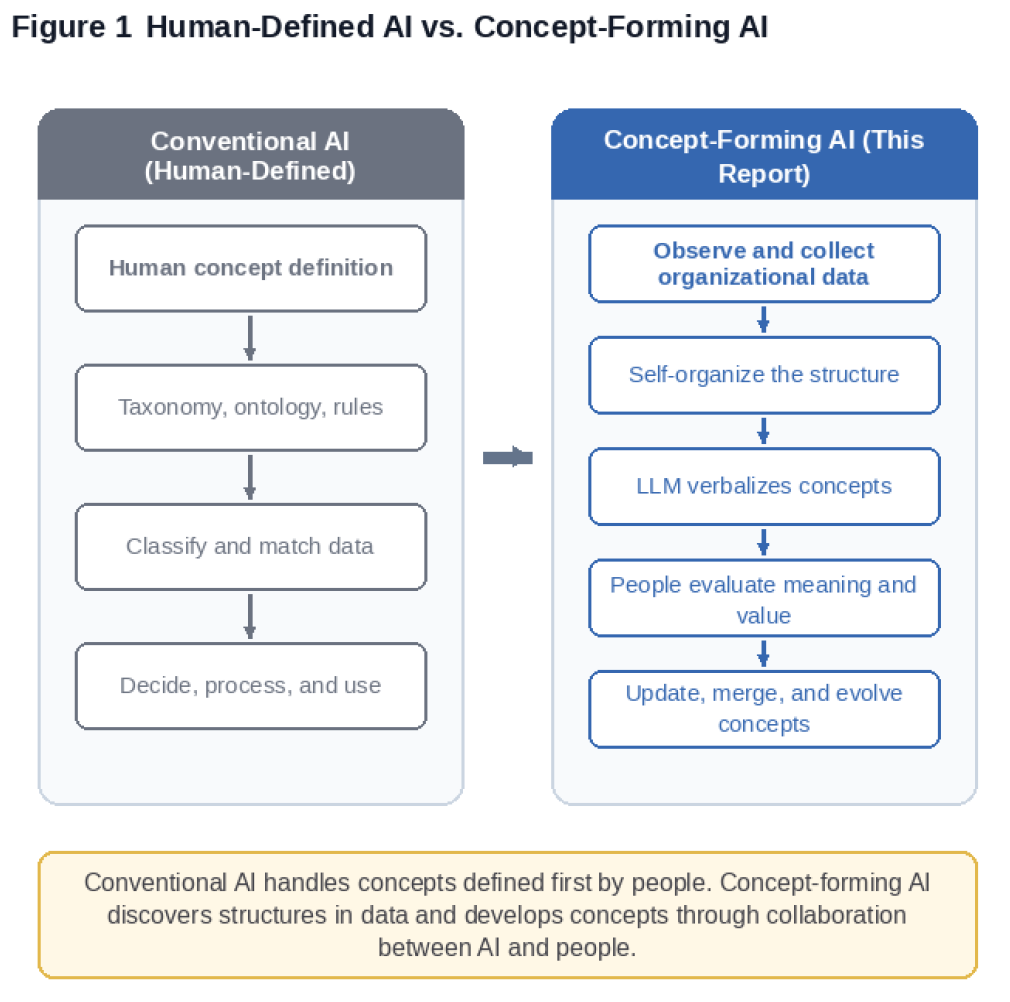
It goes further by proposing concept-forming AI: a system that continuously observes organizational information and forms structures and concepts that may not be captured by existing classifications.
The integrated foundation for this approach is the Operational World Model.
An Operational World Model connects enterprise documents, data, events, concepts, business processes, decisions, actions, and outcomes to create the following continuous cycle:
Observation
→ Formation of Information Structures
→ Concept Formation
→ Memory
→ Hypothesis and Decision Support
→ Action
→ Observation of Results
→ Updating of the Internal Model
This report examines concept-forming AI and the Operational World Model from their theoretical foundations through to concrete system architecture.
Its principal topics include:
- why LLMs, RAG, and AI agents alone cannot form an enterprise-specific cognitive foundation
- why systems based entirely on concepts and classifications predefined by humans have inherent limitations
- how embeddings, self-organizing learning, networks, minimum spanning trees, and LLMs can be combined
- how document knowledge, long-term associative memory, and episodic memory can be integrated
- what is required to reconstruct business processes from natural-language information
- how changes in concepts and operational processes can be detected over time
- how enterprise-specific states, memories, and constraints can be provided to AI agents
- what has already been implemented through ConceptMiner, Concept Index, and ThinkNavi
- what remains to be developed in order to turn the Operational World Model into an enterprise-ready product
The objective is not to create an omniscient AI that automatically understands the entire enterprise and replaces human management or professional judgment.
The goal is to create an AI foundation that continuously observes large volumes of information and presents structures, relationships, changes, and relevant past cases that human beings might otherwise overlook.
Large language models have enabled AI to work with human language.
AI agents are beginning to enable AI to act.
The next requirement is the foundation that connects language and action through concepts, memory, experience, and judgment.
This report presents the technical research, system architecture, and development plan required to move enterprise AI beyond chat and task automation toward systems that observe the organization, form concepts, and learn from experience.