
Understanding the Company’s Current State and Connecting Past Experience to Future Decisions
Large Language Models (LLMs) possess vast general knowledge and strong language capabilities. However, they do not continuously understand what is currently happening inside a particular company, what has happened in the past, who made which decisions, or what resulted from those decisions.
Companies already possess large amounts of information in documents, relational databases, business logs, email, meeting records, CRM systems, and reports. Yet these sources are usually scattered across different systems and do not form a unified model of the company’s current operational state.
Mindware Research Institute uses the term Operational World Model (OWM) for a company-specific model that continuously integrates entities, objects, states, events, decisions, outcomes, relationships, and business processes so that both humans and AI can refer to a shared representation of the company’s operational world.
Rather than defining a large fixed ontology in advance, the OWM is intended to form structures from actual documents, data, and accumulated experience, while allowing humans to review, correct, and govern what the system has learned.
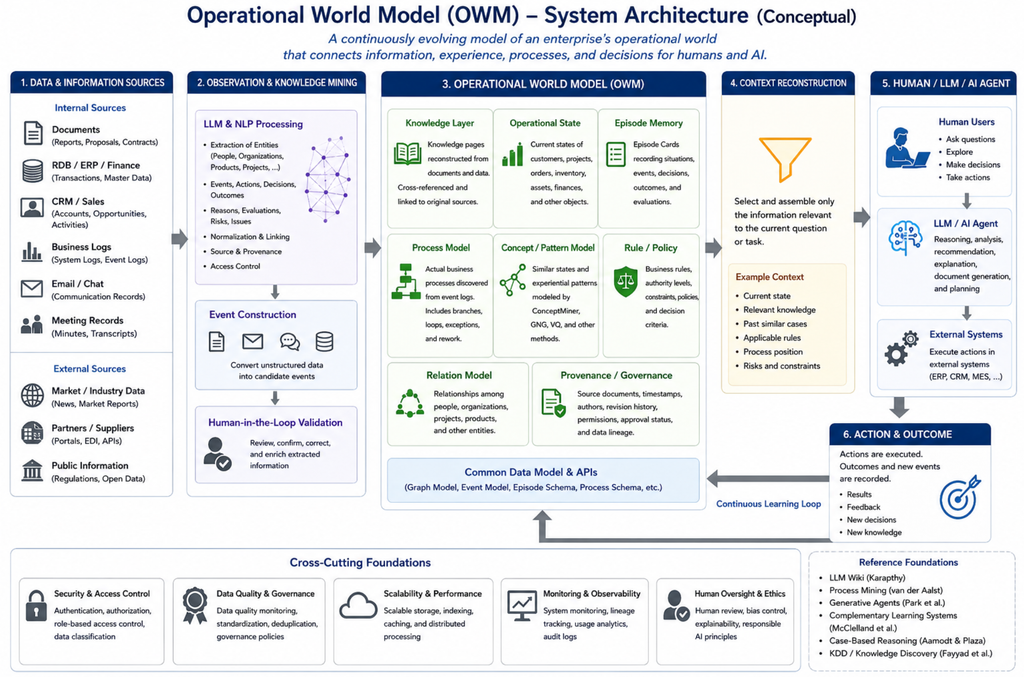
Hypothetical System Architecture
At this stage, we envision the Operational World Model as an integrated system composed of several complementary functions.
Business Information
Documents / RDB / CRM / Email / Business Logs / Meeting Records / External Information
↓
Observation & Knowledge Mining
LLM-based extraction and normalization of entities, objects, states, actions, decisions, outcomes, reasons, and other operational elements, together with provenance and access-control information
↓
Operational World Model
- Knowledge Layer — knowledge pages reconstructed from documents
- Operational State — current states of customers, opportunities, products, inventory, projects, and other business objects
- Episode Memory — Episode Cards recording situations, events, decisions, outcomes, and evaluations
- Process Model — actual workflows, branches, repetitions, exceptions, and rework
- Concept / Pattern Model — similar states, experiential patterns, and conceptual structures modeled with ConceptMiner, GNG, VQ, and related methods
- Rule / Policy — explicit rules, authority structures, constraints, and decision criteria
- Relation Model — relationships among people, organizations, projects, products, and other entities
- Provenance / Governance — original sources, timestamps, authors, revision histories, permissions, and approval status
↓
Context Reconstruction
Selection and reconstruction of only the states, knowledge, past cases, rules, and processes relevant to the current problem
↓
Human / LLM / AI Agent
Questions, analysis, decision support, dialogue, business-document generation, and interaction with external systems where appropriate
↓
Action & Outcome
New events, decisions, and outcomes are recorded back into the OWM.
The objective is not to build these components as isolated experiments, but to connect them through common schemas and APIs so that knowledge, episodes, processes, concepts, rules, and operational states can be used together.
Example: A Customer Requests a Discount
Consider a salesperson asking an AI system:
“Customer A has requested a 10% discount. How should we respond?”
A general-purpose LLM can provide generic sales advice. An OWM, however, could first reconstruct the operational context surrounding the decision.
It might retrieve Customer A’s transaction history, the current opportunity status, expected margin, similar past cases, previous discount decisions and their outcomes, internal discount-authority rules, and relevant exceptions.
ConceptMiner could identify similar past opportunities. Episode Memory could retrieve what decisions were made in those situations and what happened afterward. Rule / Policy could determine which constraints apply. The Process Model could identify the current approval stage.
The OWM would then reconstruct the relevant context and provide it to the LLM.
The fundamental idea is therefore not to make the LLM itself remember the company, but to let the company retain its own operational world and expose only the relevant parts to AI when needed.
Recording Experience and Developing Patterns
An OWM does not need to convert every new event immediately into generalized knowledge.
First, it can record what happened: the situation, the event, the decision made, the outcome, and the subsequent evaluation. These can be stored as individual Episodes.
As Episodes accumulate, ConceptMiner and other analytical methods can identify similar experiences, typical states, recurring structures, and repeated decision patterns.
This suggests a two-level learning architecture:
Episode Memory records individual experiences rapidly.
Concept / Pattern Models gradually form more general structures from accumulated experience.
Enterprise learning therefore does not have to mean repeatedly retraining an AI model. New facts can update the Operational State, new experiences can be stored as Episodes, while repeatedly useful structures can be learned as patterns when necessary.
Modeling Actual Business Processes
Business processes do not always follow manuals or formal procedures. Exceptions, rework, informal handoffs, workarounds, and unexpected branches are common.
The OWM therefore includes a Process Model representing how work actually proceeds.
Structured system logs can be used directly. Where appropriate, LLMs may also extract candidate Events from email, reports, meeting records, and other unstructured sources. After human review, these Events can be converted into event logs and analyzed through Process Mining.
The goal is to model not only what the company knows, but also how the company actually operates.
Going Beyond Analysis
One lesson from the KDD and data-mining era is that discovering clusters, decision trees, rules, or maps does not automatically produce business value. Business users cannot always translate analytical findings into operational action.
The OWM should therefore not stop at displaying analytical models.
Its outputs may also be transformed into usable business artifacts such as:
- knowledge pages;
- business manuals;
- process descriptions;
- case collections;
- decision rationales;
- improvement candidates.
The ultimate objective is to create a continuous cycle in which humans and AI use the model to support decisions and actions, and the resulting outcomes are returned to the OWM as new experience.
Research Foundations and Primary Reference Candidates
The Operational World Model is not intended as a direct implementation of any single existing theory.
The following research areas are primary design references. The project does not promise to reproduce each theory faithfully or implement all of them during Phase 1. They serve as sources of ideas that can be translated into reference implementations and evaluated in enterprise environments.
01 — LLM Wiki
Andrej Karpathy
Compile source material into reusable, cross-referenced knowledge pages rather than searching raw fragments directly.
Within the OWM, this idea provides a reference for the Knowledge Layer: restructuring enterprise information into reusable knowledge while retaining links to the original sources.
02 — Process Mining
Wil M. P. van der Aalst and others
Discover actual business processes from event logs and analyze deviations, bottlenecks, repetitions, and exceptions.
Within the OWM, Process Mining is a primary candidate for constructing and continuously updating the Operational Process Model.
03 — Generative Agents
Joon Sung Park and others
Store experience as natural-language memory, retrieve it according to relevance, recency, and importance, and use accumulated memories for reflection and planning.
Within the OWM, this research provides a reference for Episode Memory, associative retrieval of past experience, and the formation of higher-level observations from multiple episodes.
04 — Complementary Learning Systems
McClelland, McNaughton, and O’Reilly
Combine rapid recording of new events with slower formation of general structures from accumulated experience.
Within the OWM, this provides a design hypothesis for connecting rapid Episode recording with longer-term concept and pattern formation using systems such as ConceptMiner.
05 — Case-Based Reasoning
Aamodt and Plaza
Retrieve, reuse, revise, and retain past cases as a continuing problem-solving cycle.
Within the OWM, business decisions can be treated as reusable cases containing the situation, decision, outcome, and evaluation, allowing previous experience to inform new decisions.
06 — KDD / Knowledge Discovery
Fayyad, Piatetsky-Shapiro, Smyth, and others
Treat data selection, preprocessing, transformation, data mining, interpretation, and evaluation as a continuous knowledge-discovery process.
The OWM extends this idea toward operational use by converting analytical outputs into documents, process descriptions, cases, and other artifacts that business personnel can actually use.
Building an Intelligent Workbench for the Enterprise
The Operational World Model is not intended to make GNG, LLMs, Knowledge Graphs, Process Mining, Bayesian Networks, or any other single technology into a universal model.
Each method has different strengths.
The objective is to create a common operational foundation on which different forms of knowledge and reasoning can be combined according to the problem being addressed.
For this reason, we do not assume that the final architecture of the OWM can be completely defined in advance. The system will be developed incrementally by connecting information, Episodes, Processes, Concepts, Rules, and other components to actual enterprise use cases, evaluating them in practice, and expanding the common foundation over time.
Mindware Research Institute will pursue this work through the Operational World Model Consortium. In Phase 1, the central development theme will be Research Intelligence Innovation, using concrete business applications as the starting point for developing and evaluating the OWM foundation.